Showing posts with label Organic. Show all posts

Tuesday, April 21, 2015

What to do if you encounter a Vegetarian


I have another confession. I occasionally write about bacon and meat, however, I don’t actually eat them...that’s right, I am a vegetarian. GASP! Now before you write me off as a crazy hippy, hear me out. Now, I am not the type of person that is going to shove it down your throat and condemn you for eating meat ( I will however shove it down your throat that you should eat your fruits and vegetables); being a vegetarian is a personal decision. I just want to take this opportunity to educate you all on the matter because pretty much anytime I disclose that I am a vegetarian, it’s like playing 20 questions. Now, I don’t mind fielding these questions unless I get questions like this…
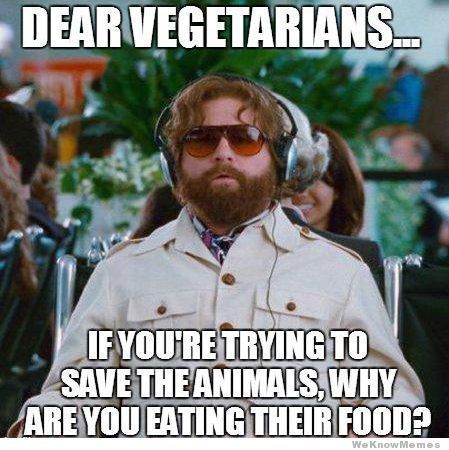
Anyways, I thought I would take the opportunity to field some of these questions for you.
Note: For the purposes of this blog and life the term meat includes the following: beef, pork, chicken, turkey, fish, shellfish, any flesh of an animal.

What is a vegetarian/vegan/pescatarian/lacto-ovo-vegetarian?
Let’s first start with defining all of these for you, so that you can vaguely know what you are talking about the next time you encounter one of these...
  • Pescatarian: The only meat they eat is fish. They may or may not eat milk, cheese, eggs, and other dairy.
  • Ovo-vegetarian: Does not eat meat but does consume eggs.
  • Lacto-vegetarian: Does not eat meat but does consume milk, cheese, and other dairy products.
  • Lacto-ovo-vegetarian: Does not eat meat but does consume milk, cheese, eggs, and other dairy products. Technically this is what I am and I would venture to say this is what people mean when they say they are vegetarian.
  • Vegan: Does not consume any animal derived product. This include honey, dairy, eggs, etc. Sometimes vegans will also not wear leather, wool, silk, etc. since it is derived from animals. Additional foods that often contain animal products include marshmallows, jello, gelatin, etc.

Why
Now this is where it gets interesting. To start with, not all vegetarians are vegetarians because we think that animals are our friends…

Other reasons for going vegetarian include:
  • Religious: Some religions not only encourage vegetarianism, but require it, such as Jainism. Religions that encourage it include Hinduism, and Buddhism, and Seventh Day Adventist.
  • Environmental: Raising animals for food requires a lot of land, food, energy, and water in addition to the pollutant byproducts that are produced by animal agriculture. According to the Water Education Foundation, it takes 2,464 gallons of water to produce one pound of beef, compared to 25 gallons for a pound of wheat. Also of note, is that the meat industry contributes to global warming by being the number one producer of methane, one of the most potent greenhouse gases. Cows are the biggest contributor to this and yes, methane is released when cows burp and fart…


          Some organizations dispute this and claim that vegetarianism is actually worse for the                         environment. I am by no means an environmental scientist and this is the most unbiased article           I could find on the topic. 
  • Health: Vegetarian diets are typically lower in saturated fats (the “bad” fat) and higher in fiber. This equates to a lower risk for developing heart disease, certain types of cancer, diabetes, obesity, and hypertension.  Some studies have also found that vegetarians live longer. 
  • Animal Cruelty: Don’t worry, I am not going to go all PETA on you and post gross pictures of suffering cows. I will however just post this…
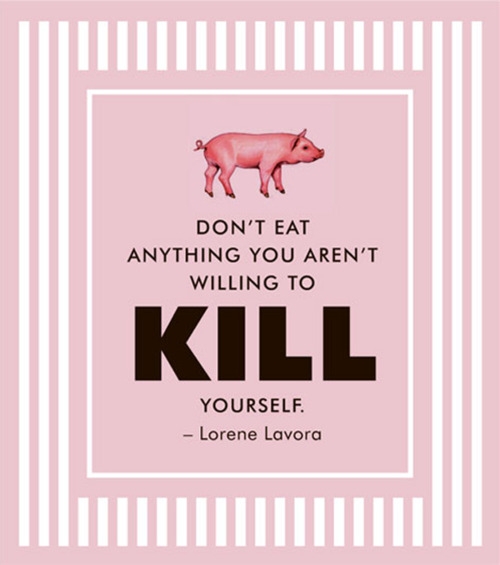

         Personally, I grew up on a farm and have participated in the butchering of chickens and                        witnessed my “pet” cow be butchered. His name was White Sox. My parents lied to me when I            asked over a  dinner of steaks shortly after his butchering if I was in fact eating White Sox.                 They assured me that they had in fact traded in White Sox’s meat for that of another cow’s. Did            this scar me and cause me to become a vegetarian? Nope.
  • Cheaper: This one is probably not a shocker; fruits, vegetables, eggs, legumes, etc are cheaper than meat. That is unless you buy everything organic but for more info on that check out my previous post.
  • To annoy people: Just kidding at least this is probably not the case in most instances but I cannot speak for all vegetarians.


So….What do you eat?
Contrary to popular belief, I don’t just eat salads; I said I was a vegetarian, not a rabbit.  I eat anything that doesn’t contain meat. Instead of focusing on what I can’t eat, let’s rephrase the question to what I can eat. Obviously this includes fruits and vegetables, but also eggs, cheese, legumes (beans), nuts, seeds, grains, tofu (no vegetarians do not eat this as much as people tend to think that they do), and so on and so forth. I think why people can’t seem to get past the “what do you eat” question is because Americans place so much focus on meat being the golden child of every meal. With that being said, I would like to share you with a video that I found highly entertaining about If Vegans Said Stuff Meat Eaters Said... 


Vegetarianism…the wrong way
Now, some foods are naturally vegetarian like chips, cookies, cake, French fries, etc. I mean Cookie Monster is technically a vegetarian...



That’s not quite the way one should do vegetarianism. Since vegetarians eliminate meat and other animal products there are some minor nutritional concerns. One of the most prevalent questions that I get is where I get my protein from. Getting enough protein is the least of my worries. There are eggs, soy, dairy, nuts, legumes, seeds, and yes even fruits and vegetables contain some protein as well.
Things to be more mindful of include: iron, vitamin D, vitamin B12 (especially if you are vegan), and calcium (again especially if you are vegan). However, vitamin D you can get from the sun and it is fortified in other foods and iron is found in plenty of non-animal sources such as spinach and raisins.

Breaking it down
I am not going to preach that everybody should be a vegetarian. I only ask that you be more cognizant of what you are eating and of course for you all to eat more fruits and vegetables. Now, I may be weird, but it is not because I am a vegetarian. Maybe it’s from the emotional scarring of eating my pet cow; I don't know but I am working with my therapist on that one :) For more information on vegetarianism that isn’t too off the wall or biased, check out The Vegetarian Resource Group. Now if you will excuse me, I need to go do my part to prevent watermelons and other fruits and vegetables from taking over the world. Until next time!

Keep it Fresh,
Keep it Green,


Beth

Tuesday, April 14, 2015

Gardening Part Deux

I have blogged about gardening in my previous blog post, Gardening: Get Your Grandma On, but after my exciting weekend of “farming,” I decided to revisit the topic. (Note: My version of farming is the four vegetable plants and four herb plants that I grow in containers on my patio. Why yes, I am thinking about getting a tractor J ) For those of you youngens, yes this is what happens to you when you get old. Oh and this happens too…


Oh and this…


Anyways, back to gardening...

Why should I grow my own produce?
Well I could ramble on in complete sentences but that does not match my current mood, so I am going to leave you with bullet points:
  •     Cheaper than buying fruits and veggies (especially if you buy organic) 
  •     Better for the environment
  •     Taste better
  •     Why not?!?

Beth’s Gardening Tips
Let me preface this section with this. I am no gardening expert, but I do play one on tv.
·        
      Sunlight: One of the biggest things to consider is sunlight. Most plants need about 6-8 hours of sunlight per day, so if you live in a heavily wooded area you may be out of luck. It is best to select an area that faces east, west, south to ensure your plants will get enough light. If you are directionally challenged, use Google maps to figure it out.
·       
      Water: Make sure you water your plants using potable water (city water or water out of your spigot). Established plants should be watered every other day or every third day. If your plants start to look limp, you should probably water them. It is best to water plants in the morning.
·       
      Soil: Your plants will only be as healthy as the soil you put them in.
·       
      What to plant: Here in Charlotte, if you plant watermelon in the fall you are just setting yourself up for failure. Just because you can get a watermelon year round in the grocery store does not mean they grow all year round here in Charlotte. I will give you a resource with more detail, but to be brief your summer crops include tomatoes, summer squash, cucumber, melons, and peppers. Fall crops include fall/winter squash, apples, pumpkins, kale, and so on. Not much grows in the winter besides hearty, dark leafy greens. Spring brings strawberries, asparagus, and lettuces.
·       
      Space: Different plants need different amount of plants. Before you go throwing 10 tomato plants in one pot, do a little research and maybe even read the seed packet or those little sticks that they stick in the seedling soil. Just a thought.
The above tips just scrape the surface of all things to consider when gardening. For more information, check out this great resource from Friendship Gardens: http://friendship-gardens.org/resources/gardening-101/

But Beth, I don’t have a lot of space
Neither do I! Luckily, for people like us, if your look up container gardening on Pintrest there are tons of cool ideas.

Local Produce on Campus
Well Beth if you are such a hippy why don’t we have any locally grown fruits and vegetables in our dining halls?!? I would say touché, but I will not because the world of food and the food industry is very complex. We actually do have some local produce in our cafeterias, albeit not consistently and is not marketed as such for a myriad of obstacles. However, even though it is not marketed as such, I am willing to bet my first unborn child that our sweet potatoes were grown in North Carolina. Dorky fact of the day: North Carolina produces over 40% of the nation’s sweet potatoes.


Anyways, incorporating more local produce into our food system is something I have been toying with since I began this job a little over a year and a half ago, so stay tuned. In the meantime, you can find Cloister Honey, Smokey J’s Salsa, Roots & Branches Artisan Crackers, and Uncle Scott’s Root beer in both of our convenience stores on campus.  

Breaking it down
Whether you have a black thumb or green thumb, or are old, young, hippy, not a hippy, country bumpkin, city kid, give gardening a try. Is it the most exciting thing in the world? Nope, but it is pretty painless and…


Plus, you can get your organic produce without the hefty price tag. Now if you will excuse me, I need to go plant my bacon seeds.


Until next time!

Keep it Fresh,
Keep it Green,


Beth

Tuesday, March 24, 2015

Organic

Without fail every time I meet someone new and disclose that I am a Registered Dietitian, I am always prompted for my thoughts on various nutrition topics, which I don’t mind; I just find it entertaining. The most recent topic that was brought up to me was organic, so I thought I would take this opportunity to enlighten you all. For the sake of this blog, I am only going to focus on organic fruits and vegetables.

Should you be buying organic? Are they more nutritious? Do you need to always shop at Whole Foods? Before we jump into those questions, let’s first take a look at what organic means.

What is organic?
Well, according to Jim Gaffigan,


Funny, yet true. Anyways, jokes aside, here is the USDA’s definition: “Organic is a labeling term that indicates that the food or other agricultural product has been produced through approved methods that integrate cultural, biological, and mechanical practices that foster cycling of resources, promote ecological balance, and conserve biodiversity. Synthetic fertilizers, sewage sludge, irradiation, and genetic engineering may not be used.” Yeah…all of that doesn't really mean anything to you does it? Didn’t think so. The USDA has a huge guide if you are really interested in all of the details, but basically for fruits and vegetables it means...
  • Land must have had none of the prohibited substances applied to it within the last 3 years
  • Crops were never exposed to irradiation, sewage sludge, synthetic fertilizers, prohibited pesticides, and genetically modified organisms were not used
  • Crop pests, weeds, and diseases will be controlled primarily through physical, mechanical, and biological controls. When these practices are not sufficient, a biological, botanical, or synthetic substance approved for use on the National List may be used.

I know, I know, blah blah blah. Basically what I want you to take away from this section is that the term organic does not mean that no sprays were used.

Why do we use pesticides?
I am not trying to trick you on this one; pesticides are used to keep pests away to stop them from killing all of the plants. Case in point, last summer I found this little gem on one of my tomato plants…


…and proceeded to scream like a little girl until I could collect myself to hit it off the plant with a stick, which didn't work very well. Luckily for me, my roommate came home to save both me and my tomato plant. Imagine if you had a whole field of tomatoes and had an infestation of these little guys, it wouldn't be pretty.

Should I buy all organic?
Well, I am not sure about you, but I don’t make enough money to only buy organic fruits and vegetables. If you are trying to be a bit more budget conscious but still want to try to go the organic route, there are some fruits and vegetables that make more sense to buy organically than others. The Environmental Working Group (EWG) puts out a yearly list of fruits and vegetables based on the amount of pesticides used in growing said crop.  EWG puts out two lists, one being the Clean Fifteen and the Dirty Dozen.

If you are ballin' on a budget...


but still want to go the organic route, you can spend your money more wisely by only purchasing the fruits and vegetables off of the Dirty Dozen list, that way you aren't paying extra for organic bananas that have such a thick peel (that you more than likely are not eating) and isn't really worth it in the long run.

Organic vs Local
To start with, organic and local are not mutually exclusive, meaning you could find some fruits and veggies that are both local and organic, but more often than not, that is not the case. So I am going to step on my soapbox for a hot second. Just because something it not labeled organic doesn’t necessarily mean that it is not. For example, if you visit a farmers market you may see some signage indicating that no sprays/herbicides/pesticides were used.  There is a good chance that this produce is organic, however becoming a certified organic farm is a very long and expensive process that small farmers may not be financially realistic. In this case, the best way to know is to ask them.
Another entire blog post could be about how you define local because there is not standard definition in terms of miles from where you live and what food products you count as local. For example,   we have a Coca-Cola bottling plant here in Charlotte, which uses local water in addition to whatever other flavorings and colorings they add to their beverages. Is that local? (Steps off soapbox)

Breaking it down
Do you HAVE to buy organic fruits and vegetables? Nope. Should you? It definitely won’t hurt you physically (maybe a little bit financially).  Are organic fruits and vegetables more nutritious? Nope. Coming from the perspective of a Registered Dietitian, I just care that you are actually eating fruits and vegetables. You may want to look all cool and all by buying only organic food, but what good is it doing you if it just sits in your fridge until you throw it out anyways? From the perspective of the pseudo hippy that I am, buying organic and/or local is better for the environment as well. Well, I am off to go tie dye some shirts while listening to Bob Dylan. Until next time!

Keep it Fresh,
Keep it Green,

Beth