Now I
know TBT usually refers to throwback Thursday but I am going to bend the rules
a little bit because it is Tuesday. For this week's blog, I wanted to throw it
back to a pervious blog that I did on eggs. I mean with easter approaching, it
just makes sense to refresh everyone's memory on eggs. Without further ado, I
give you Beth's Egg Manifesto!
With this past weekend being Easter, the question of, “which is better
for me egg whites or eggs,” emerged just as I was entering my happy place
enjoying the delightful goodness that is Reese’s peanut butter eggs. I know
what you are thinking, “GASP! You are a dietitian and you eat candy!” Yes, I
eat candy, preferably dark chocolate, but I make sure its in the shape of
fruits and veggies to make myself feel better about it. Anyways, back to the
question at hand. Obviously, the answer here is false, Reese’s peanut butter
eggs are better for you.
I suppose there is no time like the present to talk about eggs. Now eggs tend
to get a bad rap mainly because of their fat and cholesterol content. Case in
point...
Headlines like this just make me roll my eyes. I mean come on! Eggs are
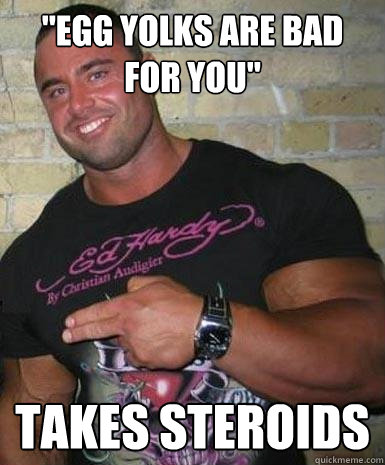
almost as bad as smoking?!? Well, then I should just light up then, right? Then there is this guy...
You know what is bad for you? Steroids. Despite these "credible"
sources, many leading health agencies can vouch for me on this one; eggs can be
part of a healthy diet.
Types of Eggs
While Easter may have us thinking of Reese’s eggs, Snickers eggs, Cadbury eggs,
and any other candy filled chocolate egg you can imagine, that’s not what I am
going to write about today. While there are actually quite a few different
types of animal eggs that you can eat, such as chicken, duck, quail, ostrich,
and fish, for all purposes pertaining to this blog we are going to talk about
chicken eggs.
Anatomy of an Egg
Since this is not a science class, I am going to simplify the anatomy of an egg
for you to focus on what is pertinent for this topic. The three parts I am
going to cover are…
Shell: I would hope that you could identify what part of the
egg that the shell is.
White: The clear-ish liquid that surrounds the yolk,
comprised mostly of protein and water.
Yolk: The yolk is the yellow part of the egg where all of
the fat and cholesterol is, half of the protein is, and where other important
vitamins and minerals are.
Egg Whites v. Whole Eggs
The ever so incredible edible egg is a great source of protein and various
vitamins and minerals, but what happens when we separate the whites from the
yolk, thus giving you egg whites? Below I have a chart for you that
outlines the main differences between the two for you. (Info based on a large
egg)
|
Whole Egg
|
Egg White
|
Calories
|
72
|
17
|
Protein
|
6
|
3
|
Fat
|
5
|
0.6
|
Cholesterol
|
186
|
0
|
Other things that I noticed while looking this up but did not put on the
chart to spare you having to look at any more of that number jibberish include:
(All of these are higher in whole eggs)
• Calcium: helps your bones and muscles
• Choline: helps support the nervous system and important for pregnant women
• Fe: helps with fatigue
• Folate: important for pregnant women
• Vit A: helps your eyes
• Vit D: helps with bone health and mood
• Zinc: helps your immune system and wound healing
So you may have noticed that egg whites are a lot lower in fat and
cholesterol. Does that mean we should all switch to egg whites since fat and
cholesterol are "bad" for our heart? No. Eating foods with
cholesterol does not raise your blood cholesterol. Additionally, research is
starting to suggest that fat not only makes food taste good, but also helps
with satiety.
What about Egg Beaters?
Egg Beaters and egg whites are essentially the same thing. The only
difference is that Egg Beaters have a ton of things added to them such as
coloring, thickeners, and some vitamins and minerals.
“What about the color of eggs”
The color of the egg has no effect on the nutritional value of the egg or on
the taste of the egg. Dorky fact of the day #1: You can tell what color of egg
a chicken will produce by the color of its ear lobe. Dorky fact of the day #2:
Chickens have ear lobes. For example, a chicken with a blue ear lobe will
produce blue eggs. Dorky fact of the day #3: Yes, blue chicken eggs do exist.
So next time you are at the store, don’t be duped into paying $1 more or
whatever more they charge for the “healthier” brown eggs.
“What about the USDA Grading?”
The USDA grades eggs by the interior quality of an egg and the appearance and
condition of the eggshell. The higher the letter (AA, A, and B) the better
quality egg you are getting. Does this have any relevant bearing on nutrition?
Nope. The size of the egg (Jumbo, Extra Large, Large, Medium, Small, and
Peewee) does have some impact on the nutrition, but have you ever seen a weight
loss tip telling you to select a smaller egg size? My guess would be no since
there is not a huge difference in calories, protein, fat, etc.
Egg Buzz Words
Cage Free: This just means that the hen has not been
confined to a cage for its whole life. They are able to walk around and stretch
out, but this does not mean that they necessarily are outside chatting it up
with Wilbur.
Free Range: This
takes cage free a step further, by providing them access to the outdoors. To be
labeled as free range, the USDA stipulates that the hens must be given
continuous access to the outdoors. Yes, the hens can eat bugs and grass like
they would in they would in the wild, but this does not mean that they are not
fed grain.
Omega-3: Usually
this just means that the hens were fed grains/feed with omega-3s in them. Does
this mean the resulting egg is magically super high in omega-3s? Does anybody
love Kanye more than Kanye? No.
Organic: This
just means that the hens were fed an organic feed, were not given antibiotics
or growth hormones, lived in cage free environment, and had access to the
outdoors.
Bottom Line
Are you pregnant or breastfeeding? If you answered yes, then you should
probably go for whole eggs. If you are unsure if you are pregnant or
breastfeeding, you should probably figure that out before worrying about
eggs. Breakfast wise, eggs are better than that pop tart, muffin, and
sugar cereal you are eating. In the battle of whole eggs versus egg whites my
thoughts are this.
1. Eggs contain fat and cholesterol just like every other animal
product, so I am not so sure why eggs are being stigmatized to the extent that
they are. Ounce for ounce, chicken contains more calories and fat than eggs.
2. Everybody needs fat in their diet, would you rather it come from a
doughnut or eggs?
3. Eggs are not what caused the obesity epidemic.
4. Does anyone actually like the taste of egg whites over a whole egg?
If you are concerned with animal cruelty then go for free range and/or
organic eggs, but be advised that does not ensure the hens have not faced some
form of animal cruelty. If you are really concerned about animal cruelty, go to
your local farmers market, get fresh eggs, and shake the hand of the person who
raised the hens themselves. Now if you will excuse me, I have some Reese’s
peanut butter eggs to tend to. Until next time!
Keep it Fresh,
Keep it Green,
Beth